Did You Know? Southern Alberta Is One of the Best Places in Canada for Solar
If you think of solar power as a technology built for California or Arizona, it's worth resetting that assumption. Southern Alberta gets more usable sunlight than almost anywhere else in Canada, and that has a real name: photovoltaic potential, a measure of how much electricity a given amount of sunlight can realistically produce in a location. Calgary ranks second among all major Canadian cities on this measure. Put another way, our region receives roughly 50% more solar energy than Germany, a country that has spent two decades building one of the largest solar industries in the world, largely through policy support rather than an especially sunny climate.
The Town of Canmore didn't take this potential on faith. In 2019, it commissioned a detailed study, Rooftop Solar in Canmore: A Neighbourhood by Neighbourhood Analysis, to map out exactly how much solar the town could realistically generate, mountains and all. The results were more encouraging than most people would guess. Yes, the surrounding peaks cast shade on parts of town at certain times of day and year. But the study found that roof design and geometry have 4.3 times more impact on a building's solar potential than its physical location within the valley. In practice, that means a well-designed roof in a shadier spot can outperform a poorly designed roof in full sun. Good solar design can outweigh the limitations of mountain geography, which is genuinely good news for a town surrounded on all sides by rock.
The study also quantified just how much untapped potential exists here. With 75% of Canmore zoned for residential development, the analysis found that residents could offset 64% of their residential electricity use through rooftop solar alone. Scaled up across every building in town, full adoption would generate an estimated 42,181 MWh of electricity every year. To put that in perspective, that's the equivalent of taking 8,600 vehicles off the road, and it would cut greenhouse gas emissions by roughly 40,000 tonnes of carbon dioxide annually. And these numbers reflect solar technology as it existed in 2019. Panel efficiency has continued climbing since then, meaning the real potential today is likely even higher.
This is exactly the gap BVGEC exists to close. Southern Alberta doesn't lack sunlight, and increasingly it doesn't lack the technology or financing models either. What it's lacked, historically, is a way to connect willing rooftops with willing investors at a community scale. When we evaluate a potential host site, we work with expert solar installers to assess exactly the kind of factors this study flagged, roof orientation, shading patterns, structural suitability, so that every project we build makes the most of the resource sitting right above us.
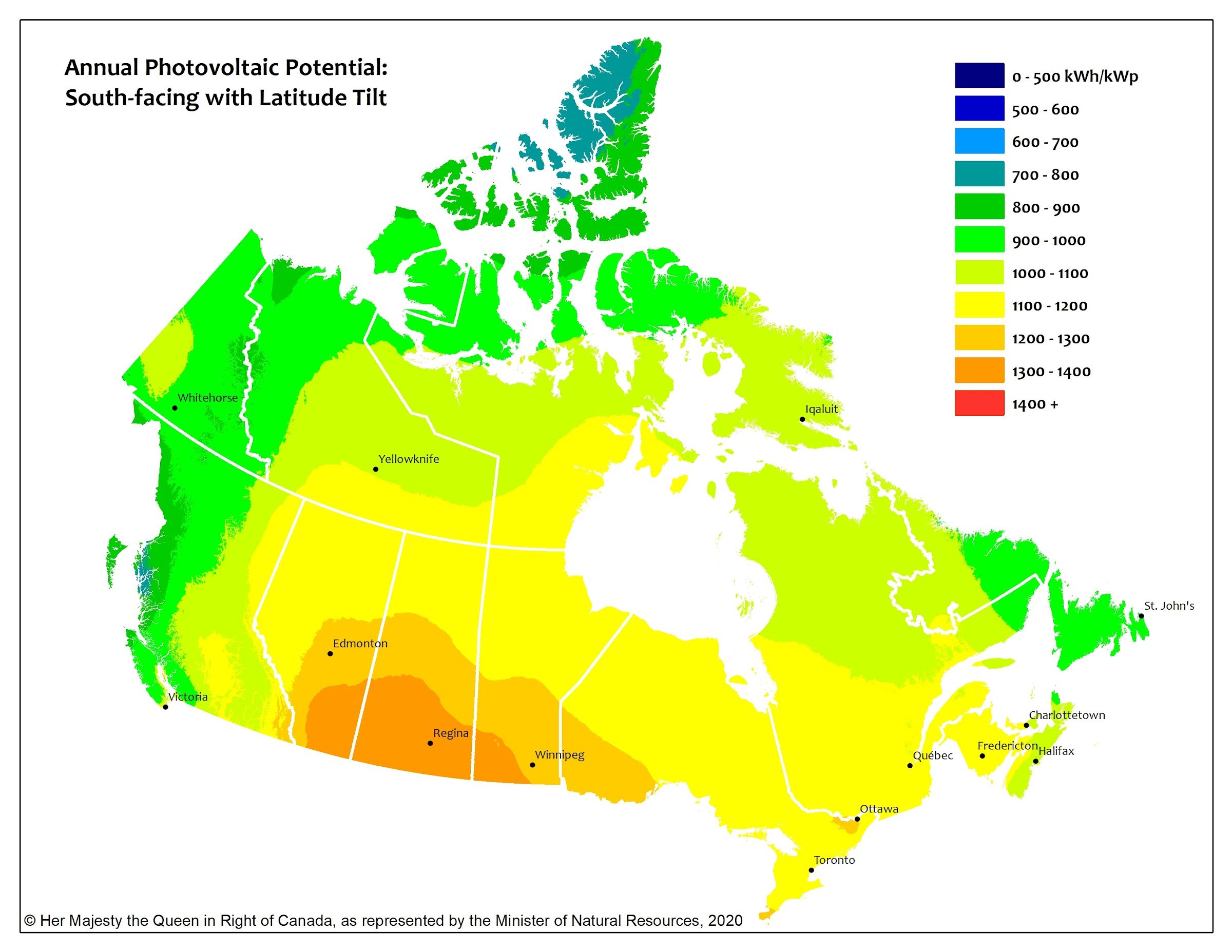
Photovoltaic potential and solar resource maps of Canada (Source: Natural Resources Canada, 2021)
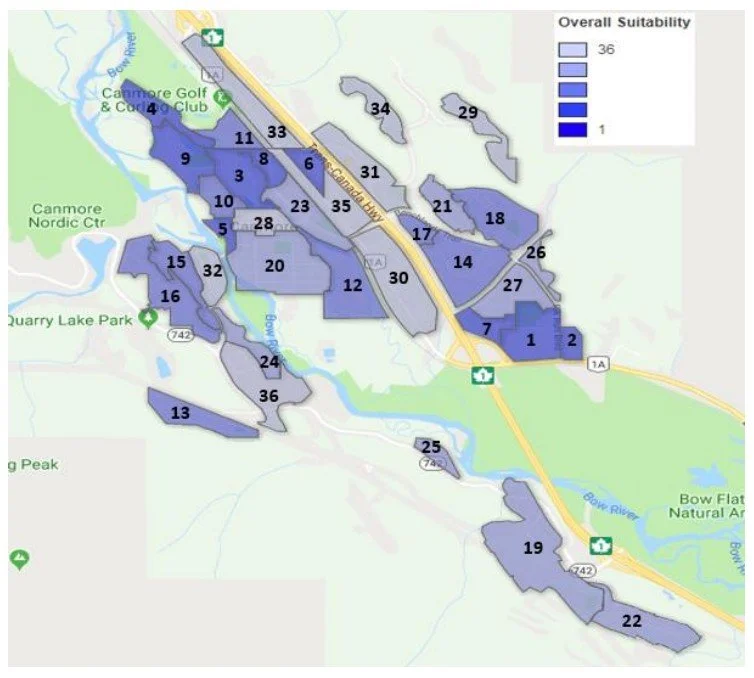
Canmore overall suitability map (Source: Ehr, Patterson & Donegan, 2019)
References:
Ehr, C., Patterson, E. & Donegan, T. (2019). Rooftop solar in Canmore: A neighbourhood by neighbourhood analysis. https://canmore.ca/documents/planning-building-development/signposts-to-sustainability/3109-rooftop-solar-in-canmore-final-report
Natural Resources Canada. (2021). Photovoltaic potential and solar resource maps of Canada. https://fgp-pgf.maps.arcgis.com/apps/webappviewer/index.html?id=c91106a7d8c446a19dd1909fd93645d3
Pelland, S. et al. (2006). The development of photovoltaic resource maps for Canada. Natural Resources Canada. https://www.nrcan.gc.ca/sites/www.nrcan.gc.ca/files/canmetenergy/files/pubs/2006-046_OP-J_411-SOLRES_PV+map.pdf