Did You know? Solar Panels Can Share Land With Almost Anything
Solar energy has an important role to play in Alberta’s transition toward a more sustainable and resilient energy system. But how and where solar projects are developed matters.
Large solar installations can generate significant amounts of renewable electricity, but they can also require substantial areas of land. In regions like the Bow Valley, where developable land is limited and wildlife corridors must be protected, there is a strong case for making better use of spaces that have already been developed.
From agrivoltaic systems on agricultural land to solar panels installed on existing rooftops, thoughtful planning can help Alberta increase renewable energy production while minimizing its development footprint.
Agricultural Land
Alberta has long been a leader in resource development, and its adoption of photovoltaic technology is no exception. As of 2019, the province was the second-highest producer of solar electricity in Canada.
Across Southern Alberta, it is increasingly common to see land once used to grow crops for food or livestock feed converted into large solar arrays. While these installations provide renewable energy, they can also remove productive agricultural land from use. Agrivoltaic systems offer a more innovative approach.
Agrivoltaics use the same area of land for both solar power generation and agricultural production. Sheep grazing beneath solar panels and growing shade-tolerant crops are two examples gaining traction. Research suggests these systems can reduce heat-island effects while improving crop production, water-use efficiency and renewable energy generation (Dinesh & Pearce, 2016; Ketzer, 2020).
Another option is to avoid using arable land altogether by installing solar panels on existing infrastructure. Rooftops and other developed spaces offer significant potential for renewable energy generation without requiring additional land. This is where BVGEC’s community-generation model can make an important contribution.
Residential and Commercial Land
One of solar energy’s greatest advantages is its ability to generate electricity using land that is already occupied by homes, businesses and community buildings.
A 2019 study commissioned by the Town of Canmore found that installing solar on every suitable rooftop in Canmore could generate approximately 42,181 MWh of electricity annually. According to the study, that would provide an emissions benefit equivalent to taking approximately 8,600 cars off the road (Ehr, Patterson & Donegan, 2019).
This opportunity is particularly important in the Bow Valley. The region is both a critical wildlife corridor and an increasingly popular place to live and visit. Expanding renewable energy generation while limiting the need for additional development can help protect the natural environment that makes the region so valuable.
Rooftop solar can also help make communities more resilient. When paired with battery storage or integrated into a microgrid, solar systems can provide greater energy security during disruptions. Homeowners, businesses and community organizations can generate their own electricity, reduce their exposure to rising energy costs and, in some cases, create an additional source of revenue (Pforzheimer & Ridlington, 2020).
Community Solar in the Bow Valley
BVGEC works with local businesses and organizations to establish solar installations on new and existing buildings throughout the Bow Valley. Projects include installations at Ralph Connor Memorial United Church, St. Michael’s Anglican Church and I-Place.
Through community-owned renewable energy projects, BVGEC also gives people who may not have a suitable rooftop or the financial capacity to install their own solar system an opportunity to participate in local renewable energy generation.
By using rooftops and developed spaces more effectively, we can generate clean electricity, strengthen community resilience and reduce pressure on agricultural land and sensitive natural areas.
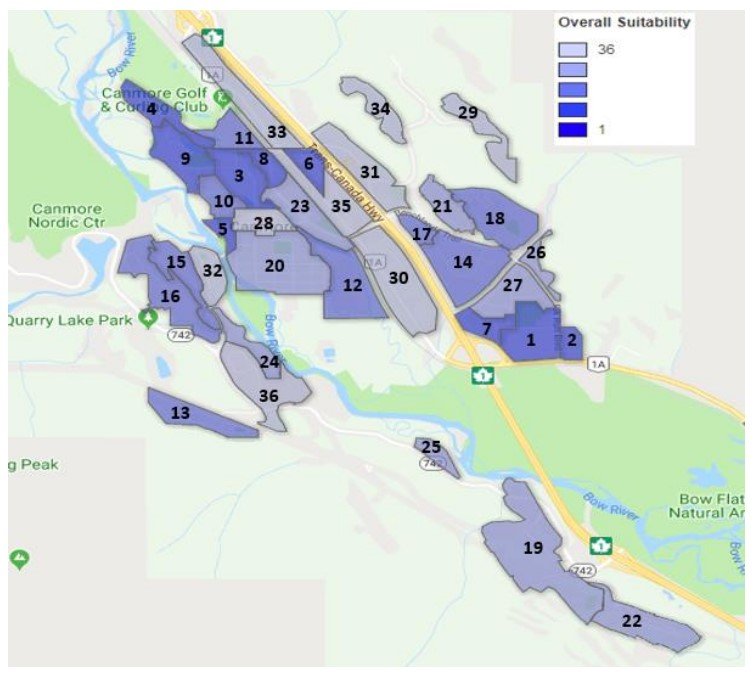
Canmore overall suitability map (Source: Ehr, Patterson & Donegan)
References
Dinesh, H., & Pearce, J. M. (2016). The potential of agrivoltaic systems. Renewable & Sustainable Energy Reviews, 54, 299-308. https://doi.org/10.1016/j.rser.2015.10.024
Ehr, C., Patterson, E. & Donegan, T. (2019). Rooftop solar in Canmore: A neighbourhood by neighbourhood analysis. https://canmore.ca/documents/planning-building-development/signposts-to-sustainability/3109-rooftop-solar-in-canmore-final-report
Ketzer, D. (2020). Land use conflicts between agriculture and energy production: Systems approach to allocate potentials for bioenergy and agrophotovoltaics. Stockholm University. https://www.diva-portal.org/smash/get/diva2:1382756/FULLTEXT02.pdf
National Renewable Energy Laboratory. (2019, September 11). Benefits of agrivoltaics across the food-energy-water nexus. https://www.nrel.gov/news/program/2019/benefits-of-agrivoltaics-across-the-food-energy-water-nexus.html
Pforzheimer, A. & Ridlington, E. (2020). Shining cities: The top U.S. cities for solar energy. Frontier Group. https://environmenttexas.org/sites/environment/files/TX_Shining_Cities_2020_scrn.pdf